Sora 3 Strategies for Creators & Brands
Sora 3 Release Date & In-Depth Predictions: From Sora 2's Limitations to Next-Gen AI Video Revolution
An in-depth prediction of Sora 3's technological leap, release timeline, and potential impact on content creators and the creative industry. Explore what revolutionary breakthroughs Sora 3 will bring beyond Sora 2.
Introduction: Beyond Sora 2, The Industry Looks Toward Sora 3
With OpenAI's Sora 2 launch in late September 2025, the field of AI video generation has once again reached a new boiling point. Sora 2's audio synchronization, enhanced realism, and "Cameos" feature have shown the tremendous progress of AI video from silent to sound. However, as technology's eternal law dictates, today's peak is the foundation for tomorrow's future. The industry's gaze has quickly moved beyond Sora 2's halo, looking toward a more distant future—the highly anticipated Sora 3.
People can't help but ask: With Sora 2 already so powerful, what revolutionary breakthroughs will Sora 3 bring? How will it address its predecessor's shortcomings? When will it arrive, and what profound impact will it have on content creators and the entire creative industry? This article will conduct an in-depth prediction of Sora 3's technological leap, release timeline, and potential impact based on existing information and industry trends.
Sora Technical Background: Evolution from Model to Application
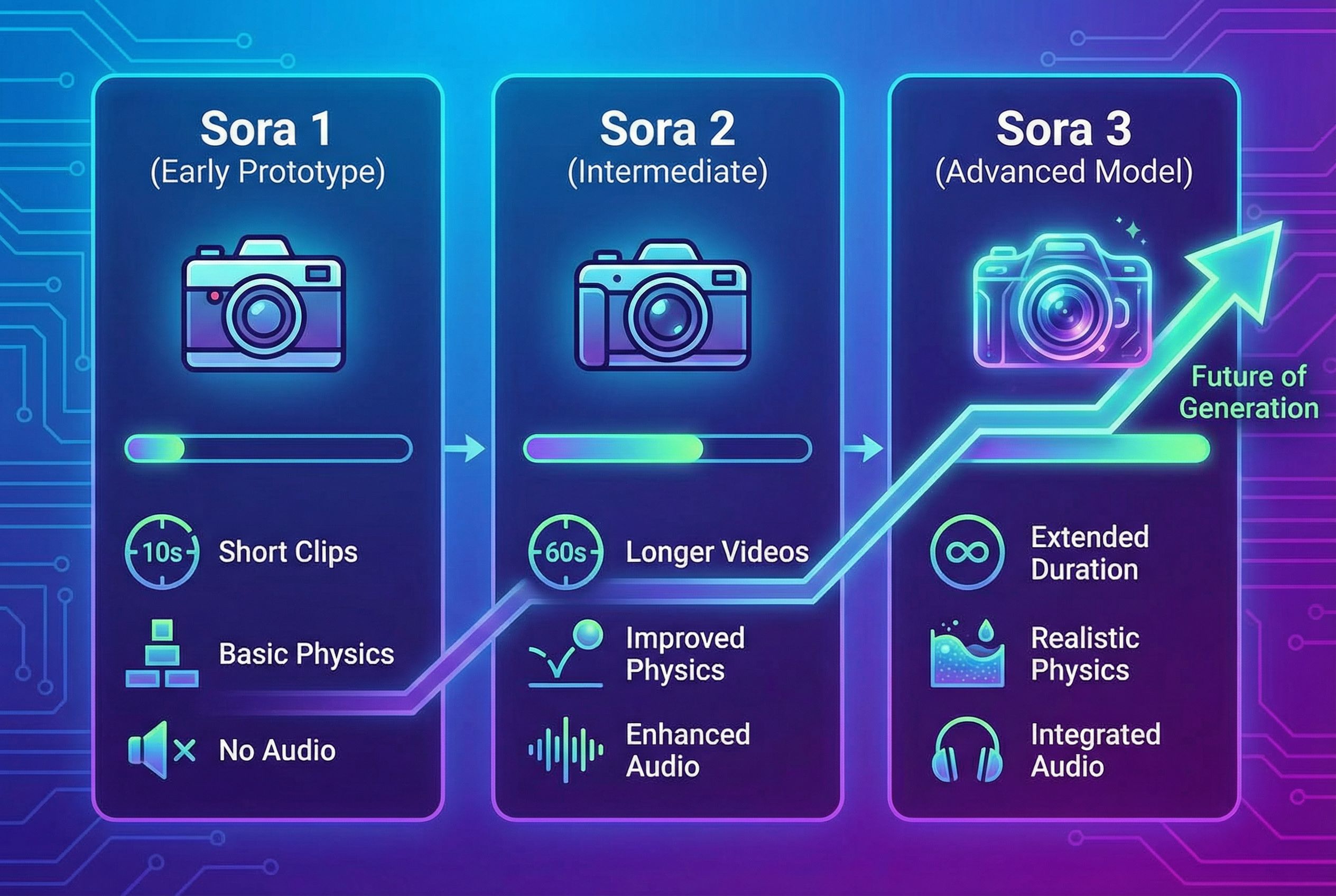
Sora's underlying technology is a diffusion transformer model that draws on DALL·E 3's success in image generation. Its core principle involves denoising video frames filled with "noise" to gradually generate coherent, clear dynamic images. In February 2024, OpenAI first previewed Sora's stunning effects and officially released the first-generation model to select users in December of that year. Although groundbreaking at the time, the initial Sora still had limitations such as inability to generate audio and occasional physical simulation distortions.
Subsequently, Sora 2's launch addressed the core pain point of missing audio and significantly improved video realism, making it ready for direct publication in many short video scenarios. This rapid iteration provides clear clues for predicting Sora 3's evolution direction.
Sora 2's Strengths and Limitations: The Springboard to Sora 3
To understand Sora 3's mission, we must first examine Sora 2's current state.
Sora 2's strengths are primarily reflected in:
-
Audio-Visual Synchronization: Capable of generating dialogue, sound effects, and background music that match the visuals.
-
Excellent Visual Quality: Outstanding performance in lighting, reflections, and camera movements, with the ability to generate clips up to 120 seconds long.
-
Multi-Scene Stitching: Built-in editor allows users to combine multiple clips into longer stories.
-
Reusable Characters (Cameos): Users can insert their own likeness into videos, achieving preliminary character consistency.
However, Sora 2's limitations are equally evident, and these limitations are precisely the fortresses that Sora 3 needs to conquer:
-
Unstable Physical World: Despite improvements, complex physical interactions (such as liquid flow) occasionally still "break down."
-
Imperfect Character Consistency: Even with reusable characters, hairstyles, voices, or facial details may still drift slightly across different scenes.
-
Difficulty with Long Video Narratives: Manual scene stitching cannot enable the model to truly understand the overall narrative, with continuity relying on human enforcement.
-
Insufficient Editing Flexibility: When dissatisfied with generated content, complete regeneration is often required, lacking fine-tuning capabilities.
These unfinished aspects are precisely why Sora 3 is held in such high expectations. Sora 3's mission is not just to generate cooler clips, but to become a truly reliable, controllable creative tool.
Sora 3 Predicted Features: The Leap from "Generation" to "Direction"
Our core prediction for Sora 3 is that it will achieve a qualitative transformation from "generating impressive content" to "building works with clear intent." Here are several major feature upgrades most likely to appear in Sora 3:
-
Longer and More Coherent Narrative Capability: This is the most widespread expectation for Sora 3. Sora 3 is expected to generate continuous footage lasting several minutes, with built-in understanding of scene transitions, pacing, and narrative flow. Users may be able to directly define scenes, rhythm, and transitions through scripts rather than manual stitching.
-
Absolutely Stable Character Memory: Sora 3 is expected to introduce an "intelligent character memory" feature, ensuring a character's appearance, voice, and personality remain absolutely consistent throughout a project, completely solving Sora 2's "character drift" problem. This will be Sora 3's key step toward professional film and television production.
-
Fine-Grained Post-Production Editing and Real-Time Control: Another key prediction about Sora 3 is stronger editing capabilities. Users may be able to perform "regional editing" (modifying only part of the frame), replace objects, adjust lighting or duration without regenerating entire clips. More visionary predictions point to a mode called "Sora Live," where creators can issue real-time commands like directors on set ("slow down the shot," "switch to night scene"), and Sora 3 updates the visuals instantly.
-
Higher Resolution and Stronger Physical Simulation: To meet professional needs, Sora 3's output resolution is expected to reach 4K or higher. Meanwhile, its physics engine will be more refined, greatly reducing "AI weirdness" and making object behavior closer to the real world.
-
Deep Audio Integration: Sora 3's audio capabilities will far exceed Sora 2. We can expect more precise lip-sync, character-specific voices, scene-aware spatial audio effects, and even the ability to generate dubbed versions in multiple languages from a single script.
-
Seamless Integration with Professional Workflows: Sora 3 will likely provide APIs, deeply integrating with ChatGPT, Adobe Premiere, and other professional editing software, supporting team collaboration and becoming a powerful component of existing creative workflows.
Sora 3 Release Date: When Can We Expect the Next Generation?
The Sora 3 release date is one of the most anticipated questions in the AI video generation community. While OpenAI has not officially announced the Sora 3 release date, we can make informed predictions based on historical patterns and industry insights.
Historical Release Pattern Analysis
To predict the Sora 3 release date, let's examine OpenAI's release timeline:
-
Sora 1: Released in December 2024
-
Sora 2: Released in late September 2025
-
Time Gap: Approximately 9-10 months between major versions
This consistent development cycle provides a crucial baseline for estimating the Sora 3 release date. If OpenAI maintains this cadence, we can project a similar timeframe for the next iteration.
Sora 3 Release Date Prediction: Q3-Q4 2026
Based on the established pattern, the most likely Sora 3 release date falls in the second half of 2026, specifically:
-
Conservative Estimate: Late Q3 2026 (September-October 2026)
-
Optimistic Estimate: Mid-Q3 2026 (July-August 2026)
-
Extended Timeline: Early Q4 2026 (November-December 2026)
The Sora 3 release date prediction centers around September to November 2026, representing a 12-13 month development period from Sora 2's launch. This slightly longer timeline accounts for the increased complexity of features expected in Sora 3, including advanced character consistency, extended narrative capabilities, and deeper workflow integrations.
Factors Influencing the Sora 3 Release Date
Several key factors could impact the actual Sora 3 release date:
Accelerating Factors:
-
Competitive pressure from Google's Veo and other AI video platforms
-
Breakthrough developments in diffusion transformer technology
-
Strong enterprise demand for professional-grade AI video tools
-
Successful beta testing phases with early adopters
Delaying Factors:
-
Complex technical challenges in achieving stable character memory
-
Regulatory compliance and safety testing requirements
-
Need for extensive computational infrastructure scaling
-
Quality assurance for professional production standards
Industry Speculation on Sora 3 Release Date
Industry analysts and AI researchers closely monitoring OpenAI's development patterns suggest the Sora 3 release date announcement could come 2-3 months before the actual release. This means we might hear official news about the Sora 3 release date as early as mid-2026.
Some industry insiders have hinted that OpenAI may adopt a phased rollout strategy for Sora 3, similar to previous releases:
-
Phase 1: Limited beta access for Plus and Pro subscribers
-
Phase 2: Gradual expansion to broader user base
-
Phase 3: Full public availability
This phased approach means the initial Sora 3 release date for beta users could precede general availability by several weeks or months.
Why the Sora 3 Release Date Matters
The significance of the Sora 3 release date extends far beyond a simple product launch. It represents a potential inflection point where AI video generation transitions from impressive demonstrations to professional production tools. Content creators, marketers, and filmmakers are eagerly awaiting the Sora 3 release date to plan their workflows and production schedules around this transformative technology.
For now, while the exact Sora 3 release date remains unconfirmed, the evidence strongly points to a second half 2026 launch, with Q3-Q4 being the most probable window. As we move through 2026, expect OpenAI to provide more concrete details about the Sora 3 release date and its groundbreaking capabilities.
Sora 3 Release Timeline Prediction: Second Half of 2026?
Regarding Sora 3's release timing, we can find clues from its iteration cycle. The first-generation Sora was released in December 2024, while Sora 2 launched in late September 2025, approximately 9 to 10 months apart.
If OpenAI maintains a similar update pace, we can reasonably predict that Sora 3's release window will likely fall in the latter half of 2026, specifically the third or fourth quarter. Of course, this is only a prediction based on past patterns; the actual release time will be influenced by various factors including technological breakthroughs and regulatory approvals. But we can be certain that the development of Sora 3 is already underway in full swing.
Impact on Creators: Everyone Can Be a "Director"
The emergence of Sora 3 will not replace creativity but will liberate it from heavy technical execution. It won't make directors unemployed; rather, it will give more people the ability to become "directors."
The biggest change is that Sora 3 will completely remove the physical barriers to creation. You no longer need expensive cameras, professional lighting, large crews, or travel between different locations. All you need is a clear creative vision, precise descriptions, and patience to refine the results. The workflow brought by Sora 3 will be closer to directing than technical operation. The core work of creators will return to story conception, emotion control, pacing design, and character development. This transformation will greatly empower independent creators, small studios, and marketing teams, enabling them to realize visual creativity that was once unimaginable at extremely low costs. The anticipation for Sora 3 is also an anticipation for the democratization of creativity's future.
Conclusion: Sora 3, Opening a New Era of AI Video Creation
From Sora 1's stunning debut to Sora 2's practical exploration, OpenAI's development path in the AI video field has been clear and determined. However, whether Sora 1 or Sora 2, to some extent they still feel like powerful "creative toys." And our predicted Sora 3 is expected to become the first truly "professional-grade creative tool."
Sora 3's core mission is to solve the three major challenges of consistency, controllability, and narrativity. Its emergence will mark a decisive transformation of AI video generation technology from "clip generation" to "film creation." When a tool can stably tell a long story and precisely control every detail, it is no longer just a technical demonstration but a completely new medium. We have reason to believe that Sora 3 will open a new era full of infinite possibilities for film previsualization, advertising production, educational content, and even personal artistic expression. What seems like distant imagination today may soon become the everyday reality that Sora 3 brings us.